
Guide: Integrating Security Controls into CI/CD Pipelines and DevOps Workflows as a GRC Analyst or GRC Lead
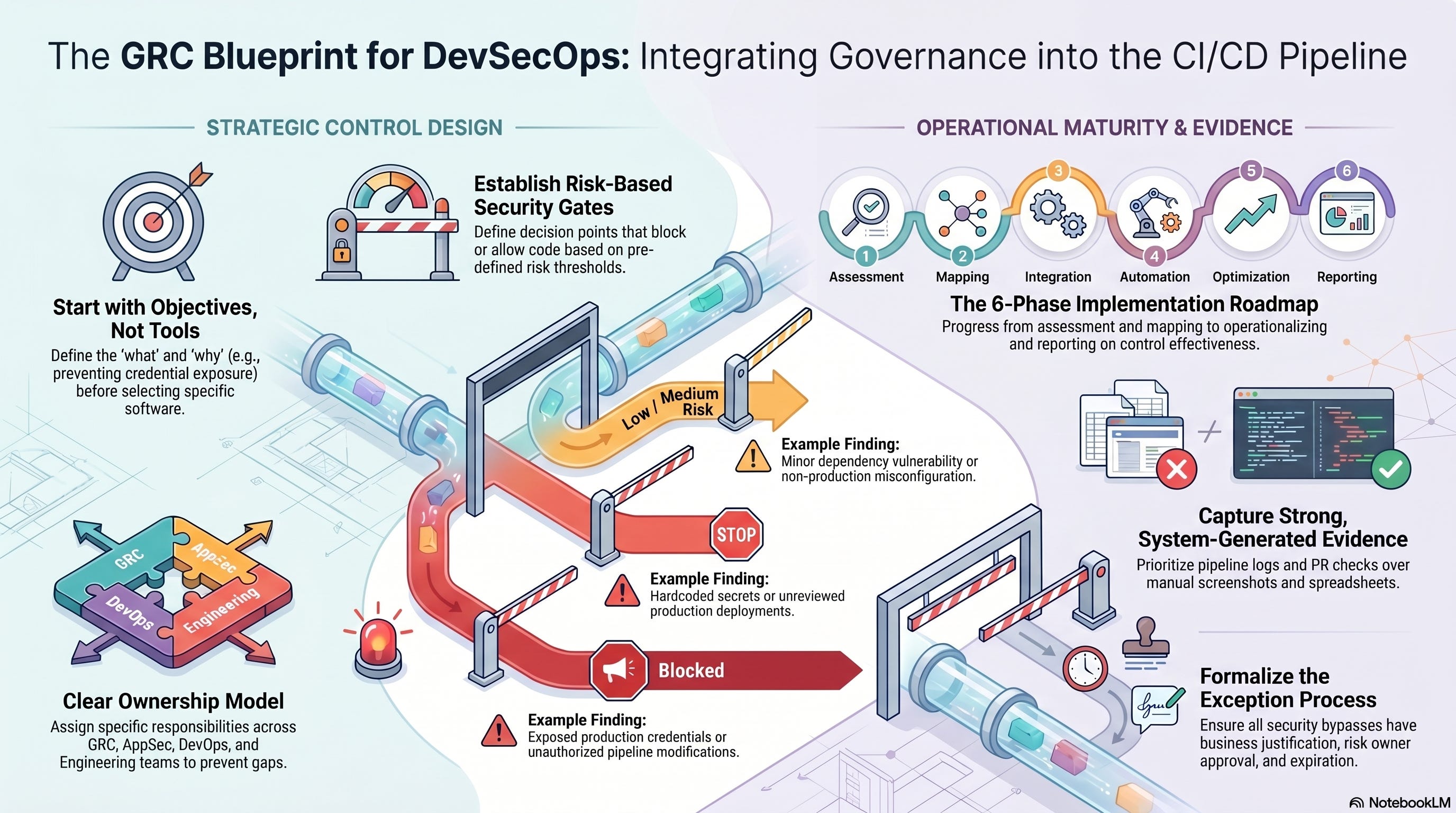
Introduction
The software pipeline has become one of the most important control environments in modern cybersecurity.
That is no longer a theory. It is happening in real time.
In May 2026, a coordinated software supply chain attack tied to the Mini Shai-Hulud campaign reportedly pushed 639 malicious versions of 323 npm packages in just one hour, targeting developers, credentials, open-source maintainers, and CI/CD environments directly. Verizon’s 2026 Data Breach Investigations Report also found that 31% of breaches now start with software vulnerability exploitation, surpassing stolen credentials as the top initial access vector.
That is the industry trend GRC professionals need to understand: attackers are not only targeting finished applications anymore.
They are targeting the systems, dependencies, pipelines, tools, credentials, and workflows used to build those applications.
This is why CI/CD security is no longer just a DevOps or AppSec topic. It is now a GRC priority.
For years, many organizations treated secure development controls as something to confirm after the fact. Code was written. Software was released. Audits came later. GRC teams were left chasing screenshots, scan reports, approval records, ticket exports, and policy attestations to prove that controls were followed.
That model is breaking down.
Modern software delivery moves too quickly for after-the-fact governance. Applications are updated continuously. Developers rely heavily on open-source packages and third-party components. Infrastructure is deployed through code. Containers move through automated build and release workflows. A single weak point in the pipeline can create exposure before a traditional review process ever catches it.
For GRC Analysts and GRC Leads, the job is not to become a developer or take ownership of the engineering pipeline. The job is to make sure security, compliance, risk management, and evidence expectations are built into how software is developed, tested, approved, and deployed. That means helping define control objectives, risk-based security gates, evidence requirements, ownership models, exception workflows, and audit-ready reporting.
The real shift is from reactive compliance to embedded governance.
When CI/CD security controls are designed well, evidence is created as the work happens. Pull requests, scan results, failed builds, deployment approvals, SBOMs, tickets, and exception records become part of the control trail. GRC no longer has to reconstruct the story months later. The pipeline tells the story in real time.
This guide is for anyone who wants to understand where the industry is going with CI/CD, DevSecOps, software supply chain security, and modern GRC.
It is especially useful for GRC professionals, cybersecurity teams, CISOs, technology managers, DevOps leaders, auditors, and newer professionals who want to understand how governance is moving closer to the actual systems where technology risk is created.
The goal is simple: help GRC professionals understand how to support governed software delivery without slowing innovation, creating unnecessary bureaucracy, or reducing compliance to manual evidence collection.
As the guide itself explains, CI/CD security control integration is not just an engineering task. It is a GRC operating model issue.
The role of GRC is to define the control requirements, map them to risk and compliance obligations, work with engineering and security teams to operationalize them, and ensure the evidence is reliable, repeatable, and audit-ready.
Table of Contents
